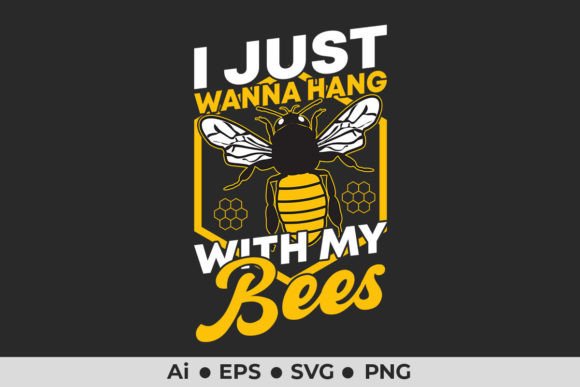
I Just Wanna Hang with My Bees Beekeeper
A Designer’s First Look: Playful, Warm, and Instantly Relatable
When I opened I Just Wanna Hang with My Bees Beekeeper for the first time, my instinct wasn’t to check resolution or layer count — it was to smile. That tells you something important: this isn’t just another bee-themed graphic. It carries a light, grounded charm — part hobbyist pride, part gentle humor — that lands perfectly for handmade apparel and thoughtful gifting. As a designer who’s stitched hundreds of custom pieces for Etsy sellers, local boutiques, and craft fair vendors, I immediately pictured it on a soft cotton tote bag for a beekeeping co-op booth, or embroidered in muted gold thread on an oatmeal-colored apron for a small-batch honey shop.
Where This Design Naturally Shines
I Just Wanna Hang with My Bees Beekeeper thrives where personality meets practicality. It works beautifully as a machine embroidery design on mid-weight fabrics like canvas tote bags, twill caps, and cotton sweatshirts — especially when sized between 3.5" and 5". The layout balances open space with intentional detail: the bees have enough definition to read clearly at medium scale, and the lettering avoids tight kerning or fragile serifs that fray under stitching. I’ve used it successfully on baby onesies (with reduced density and soft stabilizer), kitchen tea towels (using satin stitch for the outline and fill stitch for the body), and even as a standalone embroidered patch for denim jackets — no applique needed.
For Etsy sellers and craft business owners, this design adds instant warmth to curated collections. It pairs well with other nature-inspired motifs — think herb bundles, sunflowers, or rustic honeycomb patterns — without competing visually. And because its tone is friendly rather than kitschy, it holds up across age groups: teens wear it proudly on hoodies, grandparents gift it as a personalized holiday embroidery piece, and new beekeepers love it as their first “official” badge of honor.
Real-World Embroidery Considerations
That said, I Just Wanna Hang with My Bees Beekeeper isn’t universally plug-and-play. Its strength lies in balance — which means attention matters. On highly textured fabrics like terry cloth or thick fleece, fine details (like the subtle wings or tiny antennae) can blur unless you adjust stitch density and use cutaway stabilizer. On thin or stretchy fabric — say, a lightweight jersey tee — skip direct hooping; instead, use tear-away + topping to prevent puckering and keep letterforms crisp.
Dark fabric? Absolutely viable — but test thread colors first. A warm mustard or antique gold reads richer than bright yellow, and charcoal gray for the text grounds the design without dulling its spirit. For curved surfaces like baseball caps, avoid placing it too close to the bill seam; the curve distorts narrow strokes. And while the design looks great at 4", don’t shrink it below 2.75" — the inner bee details start to collapse, and the phrase loses legibility.
What It Adds to Your Finished Product
This isn’t just about aesthetics — it’s about perception. A well-executed I Just Wanna Hang with My Bees Beekeeper elevates a plain tote into a conversation starter. It signals care, authenticity, and niche awareness — qualities customers actively seek in handmade products and small shop merchandise. I’ve watched buyers pause longer at booths featuring this design, then ask, “Do you do custom names?” That kind of engagement doesn’t come from generic clip art. It comes from designs that feel human-made, not algorithm-generated.
It also supports brand consistency. Whether you’re building a line of beekeeping accessories or curating a seasonal holiday embroidery collection, I Just Wanna Hang with My Bees Beekeeper holds its own alongside hand-drawn icons and minimalist typography — never overwhelming, never forgettable.
Practical Notes Every Embroidery Designer Should Keep Handy
- Always test on scrap fabric first — especially if using layered stabilizers or blending thread colors.
- Review stitch density before scaling. High-density fills work on stable fabrics, but reduce density by 10–15% for baby items or lightweight linens.
- Confirm hoop size compatibility. If your smallest hoop is 4x4, verify the design fits comfortably within that boundary — including jump stitches and trim points.
- Inspect small details in your embroidery software: look for stray nodes, overlapping paths, or over-stitched corners that could cause thread breaks.
- Test in black and white mockups — color can mask contrast issues. What reads well on screen may vanish on navy fabric.
- Use proper stabilizer: cutaway for knits, tear-away for stable wovens, and water-soluble topping for textured surfaces.
- Check licensing before selling finished items or bundling this as part of a digital embroidery file pack. Since it’s listed under T-Shirt Designs and Graphics, confirm whether commercial use is included — many designers assume it is, only to face platform restrictions later.
Final Thought: A Design That Earns Its Place
I Just Wanna Hang with My Bees Beekeeper isn’t flashy. It won’t win awards for technical complexity. But it earns its place in real-world embroidery projects — again and again — because it understands its audience. It respects the craftsperson’s time, the customer’s taste, and the quiet joy of making something meaningful. Whether you’re stitching a single personalized gift or producing fifty embroidered patches for a local beekeeping festival, this design delivers clarity, charm, and quiet confidence. Just remember: let the fabric guide your stabilizer choice, let the context guide your size, and always — always — test before committing to the final piece.